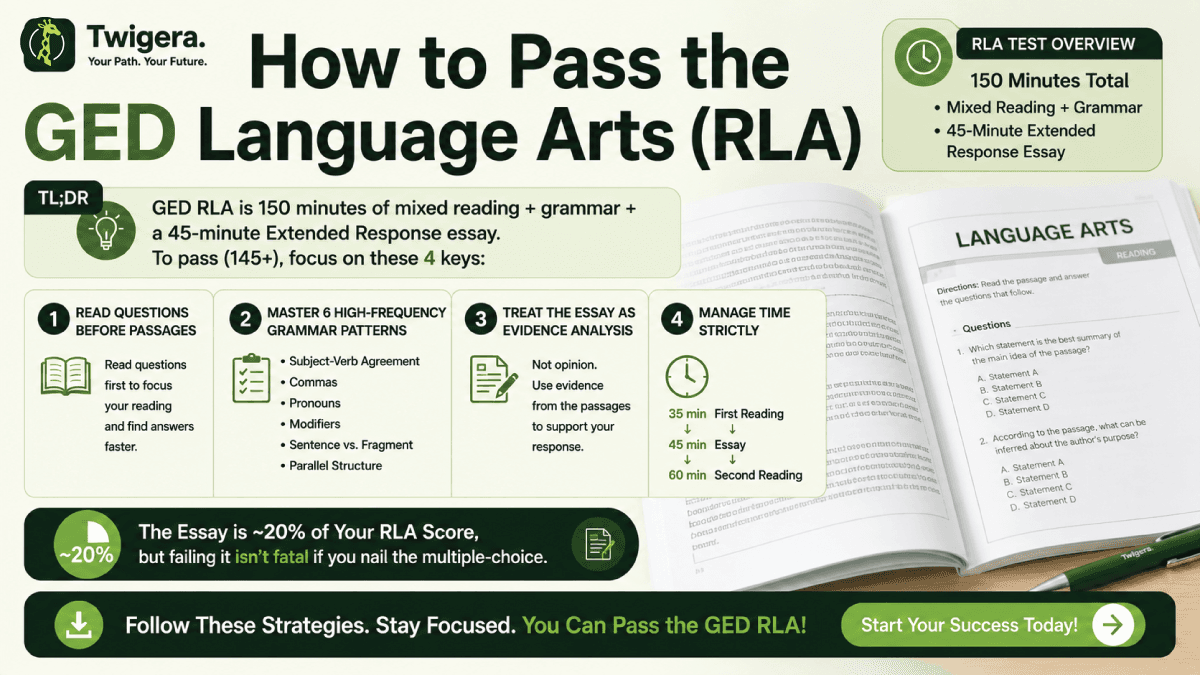
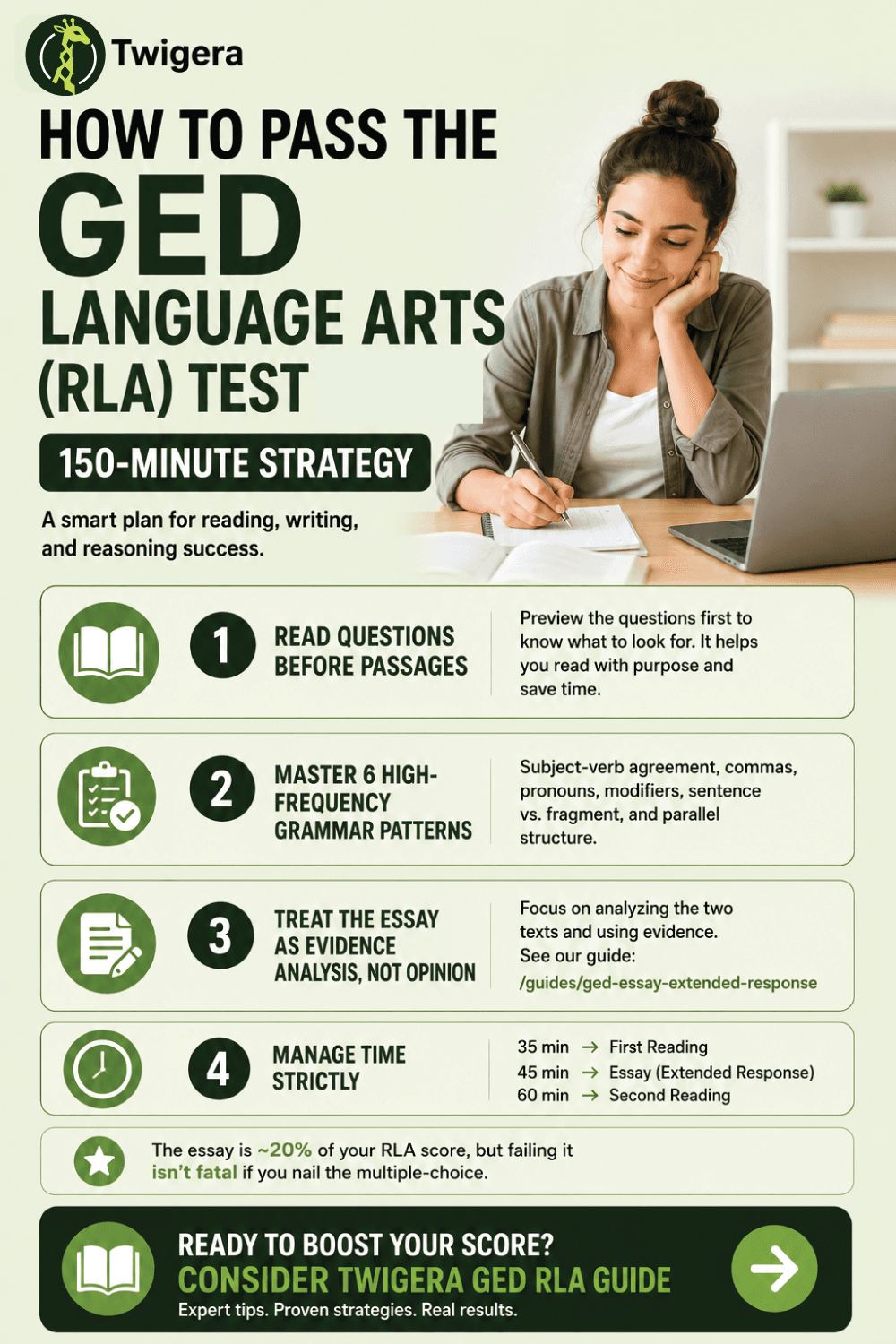
The GED Reasoning Through Language Arts test checks three skills in one sitting: reading, grammar, and evidence-based writing. Understand the structure before you start studying.
Fact | Value |
|---|
Total time | 150 minutes |
Sections | ~35 min reading 1, 10-min break, 45-min Extended Response, ~60 min reading 2 |
Score range | 100 to 200 |
Passing score | 145 |
Question types | Multiple choice, drag-drop, fill-in, drop-down, Extended Response essay |
Reading split | ~75% nonfiction, ~25% literature |
Content split | ~35% reading comprehension, 30% argument analysis, 35% grammar |
Essay weight | About 20% of the total RLA score |
RLA looks simple from the outside, but the test combines reading, grammar, argument analysis, and a timed essay. Stamina and pacing matter from the first question. The recurring failure modes are: the essay runs out of time (too long on the prompt, no time to proofread); the essay becomes a personal opinion piece (the Extended Response is evidence analysis, not opinion); passage details get missed on a single fast read; grammar patterns are shaky (especially for ESL learners but native speakers miss these too); reading stamina drops in the second half; and argument questions feel ambiguous because multiple options sound reasonable. Native English readers underestimate RLA because reading well is necessary but not sufficient — timing, grammar control, and evidence-based writing all matter just as much.
Start with a reading system, not faster reading speed. The fastest reader on the planet still loses points if their system is wrong. RLA passages run between 450 and 900 words and 75% are nonfiction — workplace documents, opinion editorials, historical speeches, and informational articles drawn from materials adults encounter in everyday work and civic life. The literature 25% includes excerpts from fiction and poetry, but the underlying skill is the same: read for the author claim, the evidence supporting it, and the rhetorical moves that connect them. Four tactics consistently raise scores without raising reading speed — they raise reading accuracy, which is what the questions actually test.
Read 2 to 3 questions before each passage, then read with those questions in mind. This helps you notice names, claims, evidence, tone, and paragraph purpose while you read. Do not read the full passage carefully before checking the questions — that wastes time, and you will probably still need to reread the same lines later. The pre-question scan also tells you what KIND of reading the test wants: a "main idea" question signals you should read for the overall claim, while a question asking about a specific quoted line signals you should slow down at that exact spot. Treat the questions as a reading map, not a finish line.
Start by removing answers that clearly do not match the passage. Wrong choices often use extreme words like "always," "never," or "all" — the GED tends to reward hedged language because most real passages hedge their claims. Better answers stay closer to the text with words like "often," "sometimes," or "primarily." After removing 1 or 2 weak choices, compare the remaining answers against the exact sentence or paragraph in the passage — not against your memory of what you read. If two answers seem equally good, the correct one is almost always the one with verbatim or near-verbatim language from the source text, not the one that paraphrases or extrapolates.
Read every option before placing your first answer. Some choices look right until you compare them with the full list. Use process of elimination when possible — if one option clearly does not fit, remove it first. If a question slows you down, flag it, move on, and return after finishing easier items. Drag-and-drop items often test sequence or grouping (chronological order, cause-and-effect, classification) — these reward careful re-reading of the passage more than speed. Drop-downs test grammar and word choice in context, so quietly read each candidate aloud in your head before committing.
RLA source texts are about 75% nonfiction and 25% fiction, with passages often ranging from 400 to 900 words. Practice reading nonfiction for 60-minute blocks — editorials, historical documents, science articles, workplace-style passages. Train your focus the same way the test uses it: several passages with different levels of difficulty, back-to-back. Reading stamina is the silent killer of RLA scores. By the time you reach reading section 2 (after the 45-minute essay), most candidates are mentally tired and start skimming. The fix is not reading faster — it is building the habit of full-focus reading for 90+ continuous minutes in practice. Workplace nonfiction (memos, policies, reports) and historical primary sources are the highest-fidelity prep because the test draws heavily from both.
GED grammar is not about memorizing every rule name. It is about recognizing the patterns the test asks you to fix inside real sentences. Grammar makes up roughly 35% of the RLA section, so it is too large to skip and too pattern-based to require deep linguistic theory. Three categories of error account for most of the grammar item points: agreement errors (subject-verb, pronoun), modifier errors (placement, dangling), and structure errors (fragments, parallelism, commas). Master those six patterns and you can solve nearly every drop-down and revision question. Grammar terminology (gerund, participle, subordinating conjunction) is rarely tested directly — what is tested is whether you can FIX a sentence that violates one of these rules.
Check whether the subject and verb match in number. Singular subject takes a singular verb: "The team was ready." Plural subject takes a plural verb: "The teams were ready." When a sentence sounds wrong, find the subject first, then test the verb beside it. The most common trap is distance — a long modifying phrase comes between the subject and the verb, and the writer matches the verb to the nearest noun instead of the actual subject. Example trap: "The list of books, papers, and reports were lost." The subject is "list" (singular), not "reports" — so the correct verb is "was." Indefinite pronouns like everyone, someone, and anyone are always singular, even when they feel plural in everyday speech.
Three high-yield comma uses cover most GED items. (1) Use a comma before "and," "but," or "or" when joining two complete sentences: "She studied for RLA, and she reviewed her essay notes." If the second half is NOT a complete sentence, drop the comma: "She studied for RLA and reviewed her essay notes." (2) Use a comma after an opening phrase: "After the break, the essay section begins." (3) Use commas around extra information the sentence does not need: "The essay, which lasts 45 minutes, tests evidence-based writing." That last category is the most-missed: if you can lift the phrase out and the sentence still makes sense, surround it with commas; if the phrase is essential to the meaning, no commas.
A pronoun must match the noun it replaces in number and case. Say "Anyone is responsible for their answer," not "Anyone are responsible" — anyone is singular even when "their" sounds plural in everyday speech (singular "they" is now broadly accepted in formal writing, including by GED graders). Make sure the reader knows who or what each pronoun refers to. Vague pronoun reference is a common wrong answer: "Sarah told Maria that she failed" — who failed? Rewrite to remove ambiguity: "Sarah told Maria that Maria had failed." The GED rewards clarity over cleverness, so when in doubt, repeat the noun.
A modifier must sit next to the word it describes. The word "only" is the classic example — meaning shifts depending on placement: "She only reviewed grammar" (her sole activity was review, with no practice) is different from "Only she reviewed grammar" (no one else did). Watch for opening phrases that do not clearly point to the subject. Dangling modifier example: "Walking to the test center, the rain started" — who is walking? Not the rain. Rewrite: "Walking to the test center, I was caught in the rain." The opening phrase has to describe whatever sits right after the comma — that is the rule the GED tests most.
A complete sentence needs a subject, a verb, and a full thought. Fragment example: "Because the passage gives strong evidence." That clause has a subject and verb but starts with "because" — a subordinating conjunction that makes it dependent. Complete: "The answer is stronger because the passage gives strong evidence." Other words that often create fragments when they start a sentence: although, while, since, if, when, after. The fix is either to attach the fragment to a nearby sentence with a comma, or to add a main clause that completes the thought. The GED expects you to spot fragments mid-paragraph and rewrite them into full sentences.
Items in a list should follow the same grammatical pattern. Correct: "I like running, swimming, and biking" — three -ing forms. Incorrect: "I like running, to swim, and biking" — the middle item breaks the pattern by switching to an infinitive. Parallelism applies to whole phrases too: "She wants to study, to practice tests, and to take the GED" — all three start with "to." Drop one "to" and the structure breaks. Watch correlative conjunctions (either/or, neither/nor, not only/but also) — whatever comes after the first word of each pair has to match grammatically. The GED tests parallelism most often in revision questions where you have to pick the answer that keeps the list balanced.
The Extended Response essay is the writing part of GED RLA, and you get 45 minutes to complete it. The test gives you two source texts that take different sides on the same issue. The key point: your job is not to share your personal opinion. Your job is to decide which argument uses stronger evidence and explain why. That means looking for clear claims, facts, examples, reasons, and weak spots in each source. The stronger argument usually gives better evidence, explains its points more clearly, and avoids unsupported claims.
A strong GED essay lands around 400 to 500 words — enough room for an introduction, 2 to 3 body paragraphs, and a short conclusion without wasting time. The essay is scored across three named traits in the official GED Testing Service rubric: Trait 1 — Creation of Arguments and Use of Evidence (the highest-weighted trait — graders look for whether you understood the two passages, compared them, and used evidence to back the stronger one); Trait 2 — Development of Ideas and Structure (organization, transitions, fully elaborated ideas extending a central thesis); Trait 3 — Clarity and Command of Standard English Conventions (sentence variety, grammar, mechanics). The essay counts for about 20% of your total RLA score — significant but not dominant.
Time | Task |
|---|
5 minutes | Read both sources |
5 minutes | Choose the stronger argument and outline |
30 minutes | Write the essay |
5 minutes | Proofread |
For a full walkthrough with graded sample essays, scoring rubric, and a 5-paragraph template, see our GED Extended Response essay guide.
RLA is easier to manage when you treat the test like a timed schedule, not one long reading task. The goal is to protect enough time for the essay while still answering every reading and grammar question.
Time | Phase | Tasks |
|---|
0:00–0:05 | Setup | Settle in, breathe, identify how many questions in reading section 1 |
0:05–0:35 | Reading section 1 | About 25 questions, aim for ~1.2 minutes per question |
0:35–0:45 | 10-minute break | Stand up, drink water, reset focus |
0:45–1:30 | Extended Response | 5 read, 5 outline, 30 write, 5 proofread |
1:30–2:30 | Reading section 2 | Remaining questions, pick up the pace where needed |
Start reading section 1 with control — read questions first, answer what you know, flag anything that needs more time. Use the break — stand up, stretch, drink water, return ready for the essay. During the Extended Response, do not start writing without a plan: choose the stronger argument, list 2-3 evidence points, then write. In the final reading section, protect your score — do not leave blanks. If time is tight, eliminate wrong answers first, choose the best remaining option, and keep moving. This timing plan avoids the two biggest RLA problems: losing essay time and rushing the final reading section.
Small mistakes cost points on RLA because the test moves through reading, grammar, and essay writing in one sitting. The habits to watch for during practice and on test day:
Writing a personal opinion essay — the Extended Response asks you to analyze which source has stronger evidence, not share your view.
Running past the 45-minute essay limit — use 5 read, 5 outline, 30 write, 5 proofread.
Reading long passages before checking questions — scan 2-3 questions first, then read with purpose.
Skipping the 10-minute break — use it to stand up, hydrate, and reset before the essay.
Reading faster than you understand — speed helps only when you still follow the author claim, evidence, and tone.
Memorizing grammar terms instead of patterns — focus on agreement, commas, pronouns, fragments, modifiers, parallel structure.
Getting overconfident as a native English speaker — RLA still requires timing, grammar control, and evidence-based writing.
Leaving blanks in the last 10 minutes — answer every remaining question even when you have to eliminate and choose.
If English is your second language, RLA needs a clear plan. The test includes long reading passages, grammar questions, and a 45-minute essay, so you need practice with both meaning and sentence control. Three options to consider:
First, check whether the GED is available in Spanish in your state. The Spanish GED follows the same passing standards as the English version. Second, apply for GED accommodations through your GED account if eligible — common accommodations include extra time, extra breaks, and a separate testing room. Apply early; do not assume you will get extra time automatically. Third, build English reading habits before the exam — bilingual dictionaries are not allowed during the test, so read nonfiction daily (news articles, opinion pieces, workplace writing, short science articles).
Set one weekly 45-minute essay practice session — read two short arguments, choose the stronger one, outline, then write under timed conditions. If you need more personal help, GED tutoring for reading, grammar, and essay feedback can show you where your sentences lose clarity and where your evidence needs support.
GED Language Arts gives you 150 minutes to handle reading, grammar, and a 45-minute Extended Response essay. To prepare well, read questions before passages, master 6 grammar patterns, manage your time on the 35-45-60 plan, and write the essay as evidence analysis, not personal opinion. If English is your second language, check whether the Spanish GED is available in your state and review accommodation options early. The 145 passing score is achievable with focused prep — the candidates who miss it usually miss it on timing or essay strategy, not on raw reading ability.