How to Pass the GED Social Studies Test in 2026: Civics Focus
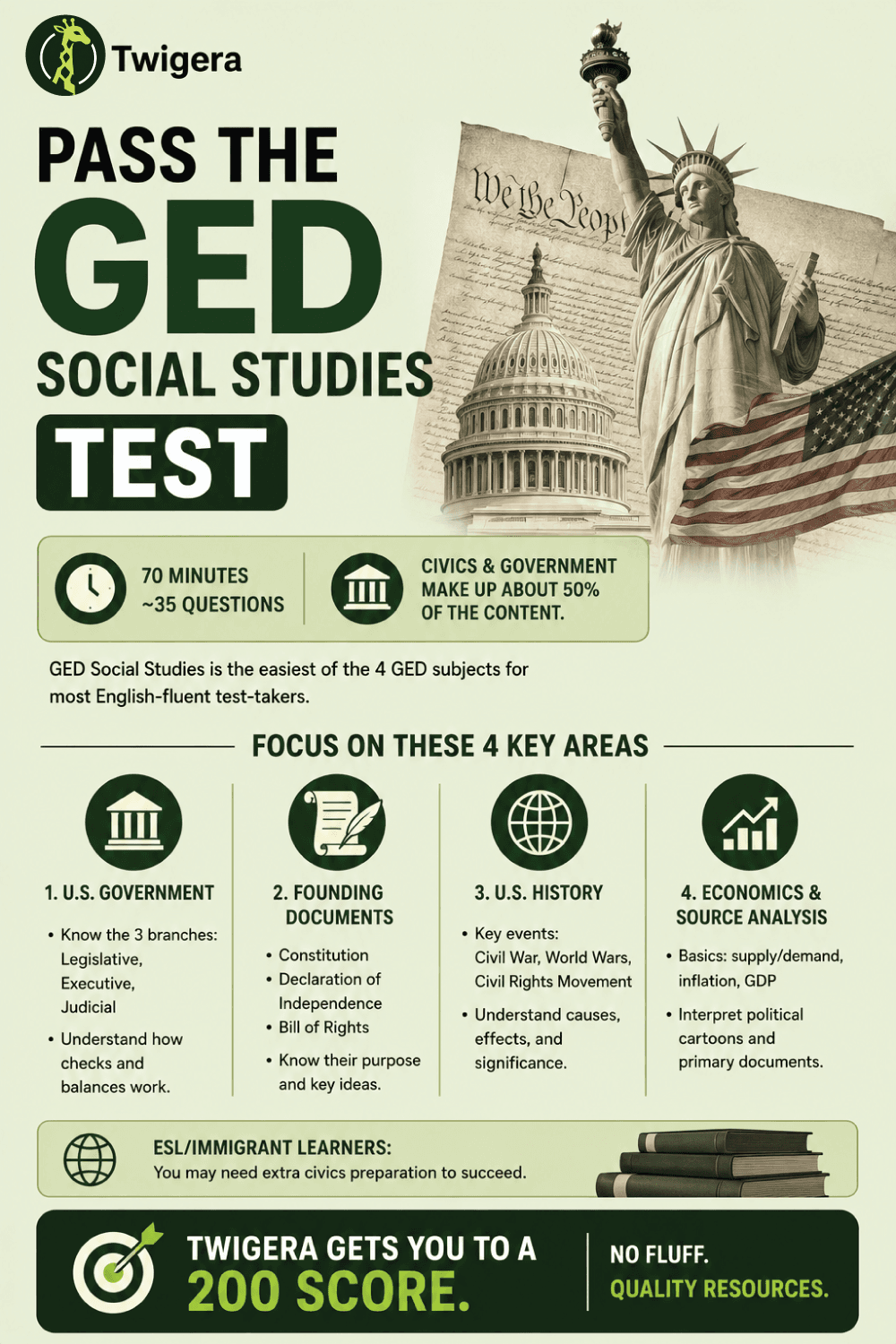
GED Social Studies is the easiest of the 4 GED subjects for most English-fluent test-takers — 70 minutes for ~35 questions with civics and government as 50% of the content. This 2026 strategy guide covers what to study first.
<p>GED Social Studies is the easiest of the 4 GED subjects for most English-fluent test takers — 70 minutes for about 35 questions. Civics and government carry 50% of the content. To pass at 145+: master the 3 branches of US government (Legislative, Executive, Judicial), founding documents (Constitution, Declaration, Bill of Rights), key historical events (Civil War, World Wars, Civil Rights), basic economics (supply/demand, inflation, GDP), and how to interpret political cartoons and primary documents.</p>
Last reviewed
You may feel tempted to focus on Math, Science, or Reasoning Through Language Arts and let Social Studies slide. Every GED subject counts, and a weak score in one area still keeps you from earning the credential. The good news: how to pass the GED Social Studies test is the most learnable problem of the four. You have 70 minutes for about 35 questions — the shortest test of the bunch — and most candidates find it the easiest GED subject. Civics and government carry 50% of the content, so a focused study plan around the 3 branches of US government, founding documents, key historical events, basic economics, and document interpretation gets you most of the way to 145.
A passing score starts at 145, while scoring 175 to 200 puts you in the College Ready + Credit range — strong enough that some colleges grant credit. This guide covers what to study first, how to read primary documents and political cartoons, the 70-minute pacing plan, and how ESL and immigrant learners should adjust their prep. For the canonical primary-source text every GED test taker should know, the National Archives publishes the founding documents (Declaration, Constitution, Bill of Rights) for free online.
Quick Facts: GED Social Studies at a Glance
Fact
Value
Time
70 minutes — the shortest of the 4 GED subjects
Question count
About 35
Score range
100 to 200 (passing: 145)
Difficulty
Often the easiest GED subject for English-fluent readers
Multiple choice, drag-drop, fill-in, drop-down, hot-spot on maps/documents
Why Social Studies Is the Easiest GED Subject
For most English-fluent readers, GED Social Studies feels easier than the other subjects because it depends more on reading and reasoning than memorizing long lists of facts. It is mostly reading-based — most questions ask you to read a short passage, chart, map, or political cartoon and choose the answer best supported by the source. There are no formulas or calculations — no algebra, no geometry, no formula sheet, no calculator. The pace is manageable — 70 minutes for about 35 questions is close to 2 minutes per question, enough to read carefully without rushing.
The main skills are teachable. Document and cartoon interpretation improve fast with practice — in 5 to 10 focused hours, you can learn how to read captions, spot symbols, understand context, and choose evidence-based answers. ESL and immigrant learners may need more civics prep because topics like the branches of government, founding documents, elections, and individual rights may not have been part of earlier schooling. If you compare difficulty across the four subjects, see our companion guides on how to pass the GED Math test, the GED Language Arts (RLA) test, and the GED Science test.
Content Domain 1: Civics and Government (~50%)
Civics and government is the most-tested area in GED Social Studies — about 50% of the exam. Start here before spending too much time on smaller domains. The test draws heavily from the founding documents (Declaration of Independence, Constitution, Bill of Rights) and from how the three branches of government actually function in practice. You do not need to memorize every Article of the Constitution; you need to understand the LOGIC — separation of powers, checks and balances, federalism, and the rights protected by the first 10 amendments. The Constitution Annotated maintained by Congress.gov and the Library of Congress is the canonical primary source for any civics question, with plain-English explanations of every article and amendment.
The 3 branches of US government
The legislative branch is Congress and its job is to make laws. Congress has two parts: the House of Representatives (435 members, representation based on state population) and the Senate (100 members, two per state). The executive branch includes the President and Cabinet — its job is to enforce laws. The President serves a 4-year term with a 2-term limit and has powers to veto bills, appoint officials, command the military, and handle foreign affairs. The judicial branch is the Supreme Court and federal courts — its job is to interpret laws. Supreme Court justices serve lifetime appointments, and the Court uses judicial review to decide whether laws follow the Constitution.
Separation of powers and checks and balances
The US government divides power so one branch does not control everything — this is separation of powers. Checks and balances means each branch limits the others. The President can veto a bill from Congress; Congress can override a veto with a 2/3 majority; the courts can strike down laws that violate the Constitution.
Bill of Rights
The Bill of Rights is the first 10 amendments, ratified in 1791. Per the National Archives, the major protections are: 1st Amendment (speech, religion, press, assembly, petition the government), 2nd (right to bear arms), 3rd (no quartering of soldiers in private homes during peacetime), 4th (protection from unreasonable searches and seizures), 5th (due process, no self-incrimination, no double jeopardy, just compensation for property taken), 6th (speedy public trial, impartial jury, right to know charges, right to a lawyer), 7th (jury trial in federal civil cases), 8th (no excessive bail or cruel and unusual punishment), 9th (unlisted rights still belong to the people), 10th (powers not delegated to the federal government are reserved to the states or the people). The 1st, 4th, 5th, 6th, and 8th show up most often on the GED.
Federal vs state government
Federalism means power is shared between federal and state governments — a structure designed by the Framers to prevent any single level of government from becoming too powerful. The 10th Amendment is the textual anchor: powers not delegated to the federal government and not prohibited to the states are reserved to the states or the people. In practice, the federal government handles foreign policy, currency, postal service, immigration, declaring war, and interstate commerce. States handle education, driver licenses, marriage laws, professional licensing, local police powers, property law, and most criminal statutes. The Supreme Court has alternated between expansive and restrictive readings of the 10th Amendment over time, most recently using it in the 1990s to limit certain federal mandates on states. For GED questions, know which level of government handles which function — that distinction is tested directly.
Voting and elections
Know the Electoral College — presidents win through 538 electoral votes total, not direct popular vote. A candidate needs 270 to win. Each state gets electoral votes equal to its number of representatives in Congress (House seats + 2 senators). Most states award all electoral votes to the popular-vote winner in that state. Know the difference between a primary election (within a party, to choose nominees) and a general election (between parties, to fill the office). Voting rights expanded through key amendments and laws: 15th Amendment (1870, voting regardless of race), 19th (1920, women), 24th (1964, no poll taxes in federal elections), 26th (1971, age 18+), and the Voting Rights Act of 1965 (banned literacy tests and other discriminatory state practices). The GED frequently tests the difference between Constitutional voting rights and statutory voting rights.
Founding documents
Know the purpose of each. Declaration of Independence (1776, declared separation from Britain). Constitution (1789, established federal government structure). Bill of Rights (1791, protected individual rights). Federalist Papers (supported ratification of the Constitution). If time is tight, master the 3 branches, Bill of Rights, federalism, elections, and founding documents first — those alone cover most of the civics 50%.
Save for later
Pin this guide so you can find it again.
We refresh these every season. Save it to a Pinterest board and you’ll get the latest version next time you come back.
US history is about 20% of the test. Study major events by cause, outcome, and impact — focus on what changed the country rather than memorizing every date. Colonial era and American Revolution: colonies broke from Britain over taxation, lack of representation, and self-government. Key dates: 1775 (fighting begins), 1776 (Declaration of Independence), 1781 (Yorktown ends major fighting), 1787 (Constitution written). Civil War and Reconstruction: causes were slavery, states rights, and economic differences between North and South. Key figures: Lincoln, Lee, Grant, Frederick Douglass. Reconstruction amendments: 13th (ended slavery), 14th (citizenship protections), 15th (voting rights for Black men).
World Wars: WWI ran 1914-1918, US entered in 1917. WWII ran 1939-1945, US entered in 1941 after Pearl Harbor. Civil Rights Movement: Brown v. Board of Education (1954) ended legal school segregation. Key figures: Martin Luther King Jr., Rosa Parks, John Lewis. The Civil Rights Act of 1964 banned major forms of discrimination; the Voting Rights Act of 1965 protected voting access. Modern era: Cold War, Vietnam War, 9/11, War on Terror, and recent political events — keep focus on causes, outcomes, and national impact.
Content Domain 3: Economics (~15%)
Economics is about 15% of the test. Focus on basics, not advanced theory. Supply and demand: prices rise when demand exceeds supply; prices fall when supply exceeds demand. Inflation: a general rise in prices over time that reduces purchasing power. GDP (Gross Domestic Product): the total value of goods and services a country produces in a year — a basic measure of economic activity. Scarcity: the gap between unlimited wants and limited resources. Taxes: how governments raise revenue. Markets vs command economies: who decides what gets produced (markets via prices vs governments via central planning).
Content Domain 4: Geography (~15%)
Geography is about 15% of the test. The goal is basic understanding, not memorizing every country or capital. US regions: Northeast, Midwest, South, West — know where major states and cities are located. Continents: Africa, Antarctica, Asia, Australia, Europe, North America, South America. Climate vs weather: climate is long-term patterns; weather is daily conditions. Map reading: compass rose, scale, legend, latitude, longitude — these tools help you understand direction, distance, symbols, and location. Cultural geography: languages, religions, population patterns, migration, demographics. Lock these basic items in and the geography points are secured.
Document and Political Cartoon Interpretation
Document and cartoon interpretation is where many GED Social Studies points are won. The test often gives you the answer inside the source — you just need to know where to look. Primary documents are original records from a time period — Constitution excerpts, presidential speeches, historical letters, court decisions. Start with the title, author, date, and opening lines. These details tell you who wrote the document, why, and what issue it addresses.
Political cartoons use symbols, labels, exaggeration, and satire. Steps to interpret: (1) identify the subject — what event, person, law, or issue is being shown; (2) notice the exaggeration — which features, actions, or objects are enlarged or distorted; (3) look for labels and captions — these often give the strongest clue about meaning; (4) consider the context — when was the cartoon created and what was happening at that time; (5) identify the message — is the cartoonist supporting, criticizing, warning, or mocking? Charts and graphs: read the title first, then check dates, labels, numbers, and trend before choosing an answer.
Time Strategy for GED Social Studies
GED Social Studies gives you 70 minutes for about 35 questions — roughly 2 minutes per question. A clear timing plan helps you avoid spending too long on one hard item while easier points wait.
Time
What to do
0:00–0:25
Answer the first 15 questions. Move steadily; save time on easier items.
0:25–0:50
Work through the next 15 questions. Flag confusing items and keep moving.
0:50–1:05
Finish the last 5 questions; return to flagged questions.
1:05–1:10
Check for unanswered questions; make your best choice before time ends.
Do not leave any question blank. If a question takes too long, flag it, move on, and return after finishing the rest.
Top Mistakes on GED Social Studies
Memorizing dates only — learn causes, outcomes, and why events changed the country.
Skipping civics — civics carries 50% of the test; review government structure first.
Ignoring documents and cartoons — many questions ask you to read sources, not recall facts.
Confusing federal and state powers — know which responsibilities belong to each level.
Overstudying world history — GED Social Studies is more US-focused.
Skipping economics — supply and demand, inflation, and GDP are basic but useful.
Forgetting the Bill of Rights — know the major protections in the first 10 amendments.
Mixing up climate and weather — climate is long-term, weather is day-to-day.
GED Social Studies for ESL and Immigrant Learners
For ESL and immigrant learners, GED Social Studies may need extra prep because US civics terms are not always familiar — government language, founding documents, elections, and rights in a new context. Start with US civics basics: 3 branches of government, checks and balances, federal vs state powers, and the Bill of Rights. These topics appear often and help you understand many test questions faster.
Use learner-friendly resources. Khan Academy AP US Government is free and explains government concepts clearly. USAHello Classroom is designed for immigrants and refugees learning US-based content. Review your testing options — if language affects performance, check GED accommodations before scheduling, and consider the Spanish-language GED option if it fits your needs. Build civics vocabulary as you study — write down new terms and practice with short GED-style questions.
The Bottom Line
GED Social Studies is often the easiest GED subject for English-fluent learners, but it still needs focused preparation. You have 70 minutes for about 35 questions, with civics and government taking the largest share (50%). Focus on the 3 branches of government, founding documents, key US history events, basic economics, geography, documents, and political cartoons. With 8 to 20 hours of focused study, most US-raised candidates clear 145 comfortably — and ESL or immigrant learners reach the same target with 20 to 40 hours after extra civics prep.
Frequently asked
Questions people ask.
Is the GED Social Studies test hard?
ShowHide
For most English-fluent readers, it is the easiest GED subject. The test is 70 minutes for about 35 questions, with 50% on civics and government — topics most US-raised candidates have basic familiarity with. Reading skill plus basic civics knowledge equals pass.
How do I pass the GED Social Studies test?
ShowHide
4-step strategy: (1) master civics and government (50% — 3 branches, founding documents, Bill of Rights); (2) know key US historical events (Civil War, World Wars, Civil Rights Movement); (3) cover basic economics (supply/demand, inflation, GDP) and geography (US regions, map reading); (4) practice document and political cartoon interpretation.
What is on the GED Social Studies test?
ShowHide
Four content domains: civics and government (~50%), US history (~20%), economics (~15%), geography (~15%). Heavy emphasis on interpreting primary documents (Constitution excerpts, speeches) and political cartoons.
How long is the GED Social Studies test?
ShowHide
70 minutes — the shortest of the 4 GED subjects. About 35 questions, so roughly 2 minutes per question. No formula sheet and no calculator are provided for this section.
What is the passing score for GED Social Studies?
ShowHide
145 out of 200 — the same passing score as the other 3 GED subjects. College Ready is 165; College Ready + Credit is 175.
What civics content does the GED Social Studies test cover?
ShowHide
Highest priority for GED Social Studies civics: the 3 branches of US government (Legislative, Executive, Judicial), separation of powers, Bill of Rights, founding documents (Declaration, Constitution), federal vs state government, and how elections work (Electoral College, primary vs general).
Is the GED Social Studies test hard for immigrants or ESL learners?
ShowHide
It can be — civics content (US government structure, founding documents) may be unfamiliar to those not raised in the US K-12 system. Recommendations: extra civics prep time, USAHello Classroom (designed for immigrants), Khan Academy AP US Government, GED accommodations for ESL, or consider the Spanish-language GED option.
How long should I study for the GED Social Studies test?
ShowHide
Typically 8 to 20 hours for English-fluent US-raised candidates — less than other GED subjects. 20 to 40 hours for ESL or immigrant learners, or those who have not engaged with US civics in a while. Take a diagnostic test first to set timing.
Amara is the editor at Twigera. She came to publishing the long way — a decade teaching the GED in community colleges and adult-learning centers, where she watched students pass not on talent or time, but on the strength of a study plan they actually trusted. Now she shapes the guides students read here for the parent studying after a closing shift, the second-career welder, the grandmother finishing what she started forty years ago. Expect honest timelines, math made survivable, and study plans built around real life — not around a textbook's idea of one.
Enjoyed this?
Take the next step — start today.
Our online GED course includes every subject, a 45-minute diagnostic, and a Pass Guarantee on the Pro plan.