Can You Be a CNA with a GED? Yes — Here's the Honest Path
Federal CNA rules don't require a GED — just 75 training hours and a competency exam. State, school, and employer policies decide the rest. California allows certification without a diploma; Florida adds rules for under-18 candidates.
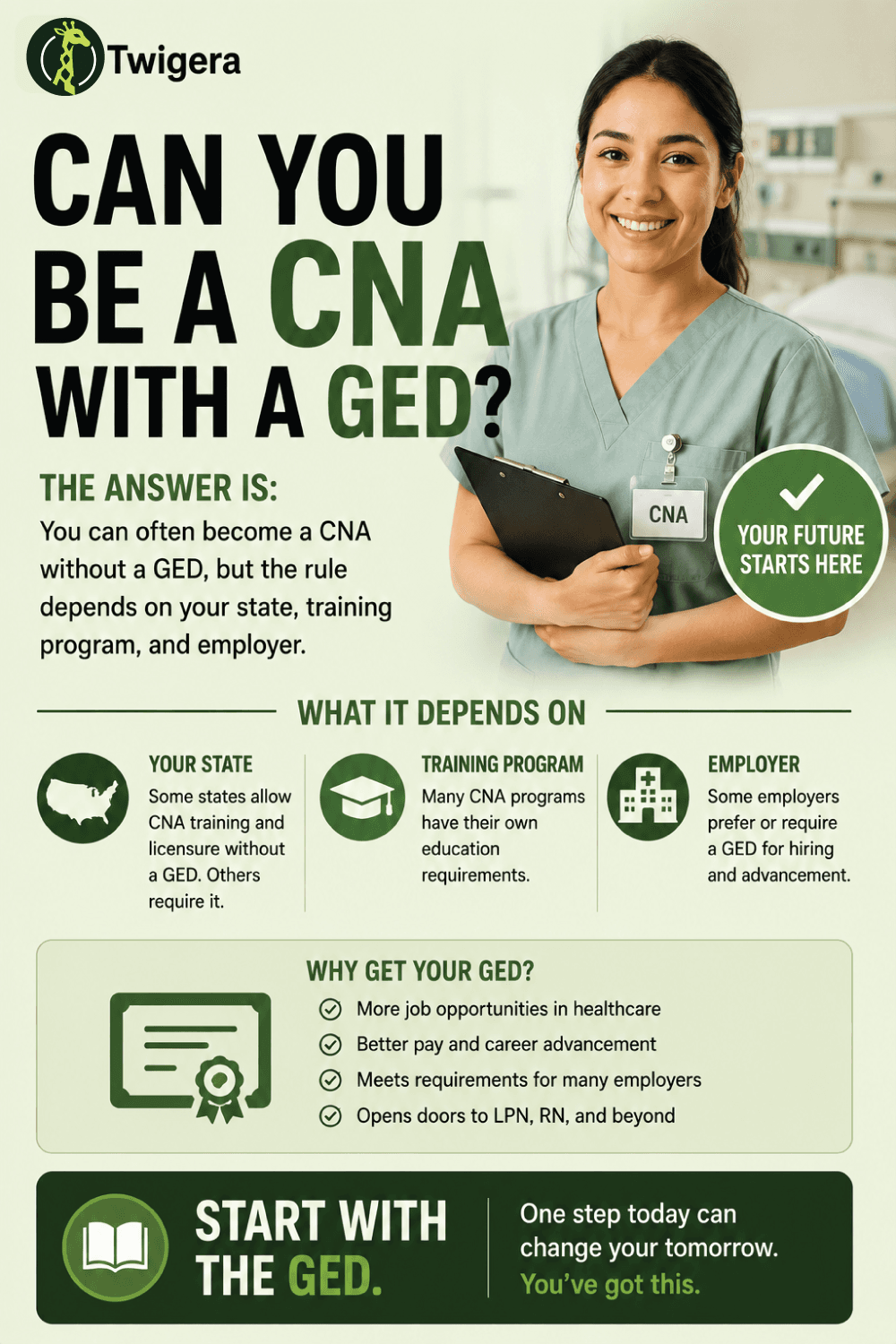
<p>Yes. You can be a CNA with a GED, and in some states you can train without one. Federal CNA rules require 75 supervised training hours and a competency exam, not a high school credential. California has no diploma rule; Florida requires one for under-18 candidates. Schools and employers can still set stricter requirements.</p>
Last reviewed
A certified nursing assistant role is one of the most accessible doors into healthcare. You work closely with patients, support their daily needs, and help nurses keep care on track.
The education requirement is where many people get stuck. Some CNA programs accept students without a GED, while others ask for a high school diploma or equivalent before enrollment. Employers can also set their own hiring rules, even when the state does not require one.
That is why the question do you need a GED to be a CNA deserves a clear answer, not a guess. GED Testing Service reports that more than 20 million people have earned GED credentials since the test began, and nearly all U.S. colleges and employers accept it.
This guide explains when a GED is required, when CNA training without a GED is possible, how state rules differ, what training involves, and how to choose the safest next step before you enroll.
Quick Answer About GED and CNA
The short answer is yes — a GED can help you become a CNA, but it is not always required by state law.
Federal CNA rules focus on approved training and a competency exam, not a GED. CMS requires state-approved nurse aide programs to include at least 75 clock hours of training and at least 16 hours of supervised practical training. That is the federal baseline.
State rules can add more requirements. Schools can add their own entry rules. Employers can also decide they want applicants with a high school diploma or GED before hiring. So the safest answer is to check before paying for a program.
How to Become a CNA with a GED
A GED gives you a stronger starting point if your training program or employer asks for a high school equivalent. Here is the usual path.
Step 1. Earn your GED if required
Start here if your state, school, or employer requires a GED. Some people also choose this step first because it protects future healthcare options. GED Testing Service lists 145 as the passing score for each subject, and 145 or higher on all four subjects earns the high school equivalency credential. If you want a structured online plan, see how to get your GED step by step.
Step 2. Find a state-approved CNA program
Do not choose a random course because the price looks low. Look for a program approved by your state. CNA programs often run through:
Community colleges
Vocational schools
Nursing homes
Hospitals
American Red Cross locations
Workforce training programs
Training often takes 4 to 12 weeks.
Step 3. Complete training
CNA training includes classroom instruction, skills practice, and supervised clinical work. You learn how to care for patients safely before working on your own.
Step 4. Pass the competency exam
Most states require a written test and a skills test. If you pass, your name goes on the state nurse aide registry.
Step 5. Apply for CNA jobs
Start with nursing homes, hospitals, home health agencies, assisted living facilities, and hospice providers. Keep your certification active through renewal and continuing education rules in your state.
State-by-State CNA GED Requirements
State rules are not identical. Some states have no explicit GED requirement for CNA certification. Some require a high school diploma or GED. Others set age, reading, or training entry rules instead.
Use this table as a practical guide, then confirm with the official state agency before enrolling.
State
State-level GED rule
Training note
What to check
California
No state GED or high school requirement for CNA certification
State-approved CNA training required
Program entry rules
Texas
No state GED rule confirmed for certification
Texas lists 60 classroom hours and 40 clinical hours for nurse aide training
Employer hiring rules
Florida
Age dependent
GED or high school diploma commonly required for under-18 candidates
Board and program policy
New York
High school diploma or equivalent required for training entry
100 hours, including clinical training
NY training provider policy
Illinois
No state high school or GED rule for CNA certification
Education minimum may apply
Program policy
Ohio
High school diploma or GED required
State-approved training required
State and school rules
Georgia
Reading proficiency required, not a state GED rule
State-approved training required
Reading test and school rules
Pennsylvania
No state GED rule found for certification
Programs and employers often set requirements
Hiring policy
Even if your state allows CNA training without a GED, a GED can still make the next step easier when a school or employer has stricter rules. For state-specific guidance, see our California GED guide or the Florida GED guide.
California is the largest state with no diploma rule for nurse aide certification. You still need state-approved training and the competency exam, but the credential itself is not blocked by missing a high school equivalent. Many California learners still pursue a GED because individual employers and bridge programs into LPN or RN often require one.
CNA Training and What to Expect
CNA training is short, but it is serious. You are preparing to work with patients who need daily help, safe movement, observation, and respectful care.
Federal rules require approved nurse aide training to include key safety and care topics before students provide direct resident care. The eCFR lists required areas such as communication, infection control, safety procedures, independence, resident rights, and basic nursing skills. Expect three parts.
Classroom learning
This covers the knowledge behind patient care. Common topics include basic anatomy, infection control, patient rights, communication, documentation, nutrition, death and dying, and safety procedures.
Lab practice
This is where you practice skills before clinical work. You may learn how to take vital signs, help with bathing and dressing, transfer a patient safely, use gait belts and lifts, make an occupied bed, and support mobility.
Clinical training
Clinical hours happen in a real healthcare setting under supervision. You work with patients while an instructor watches your safety, technique, communication, and professionalism.
Program length varies by state. Some intensive programs finish in about four weeks. Many standard programs take six to eight weeks. Part-time programs can run 12 weeks or longer.
Costs vary too. Paid programs often range from $500 to $2,500. Free or lower-cost options may come through long-term care facilities, community colleges, workforce funding, or employer-sponsored training.
Save for later
Pin this guide so you can find it again.
We refresh these every season. Save it to a Pinterest board and you’ll get the latest version next time you come back.
CNA work is often an entry point into healthcare. It is not the highest-paid healthcare role, but it can help you build patient care experience, references, and confidence before moving into LPN or RN training.
According to BLS, nursing assistants earned a median annual wage of $39,530 in May 2024. BLS also projects 2 percent growth for nursing assistants and orderlies from 2024 to 2034, with about 211,800 openings per year, mostly from workers leaving the field or changing jobs.
Pay depends on location, setting, shift, experience, and employer. Urban hospitals may pay more than rural facilities. Travel roles and specialty settings can also pay above the median, but rates change by market.
A common healthcare ladder looks like this:
CNA, usually 4 to 12 weeks of training
CNA with experience, often 1 to 2 years
LPN, often a 1-year practical nursing program
RN, often a 2-year associate degree or 4-year bachelor's degree
Specialty nursing or leadership roles
A GED can support this ladder because many LPN and RN programs require a high school diploma or equivalent. If a nursing career is the longer goal, our GED to RN guide walks the full path. A GED is also widely treated as equivalent to a high school diploma by healthcare employers.
Free CNA Programs That Can Lower Training Cost
CNA training does not always have to cost thousands. Free programs exist, but they usually come with eligibility rules, limited seats, or a work commitment.
Long-term care facility training
Some nursing homes and long-term care facilities train future CNAs at no cost. In return, they may ask you to work for them after certification. Read the agreement before signing.
American Red Cross programs
The American Red Cross offers CNA training in some locations. Availability and cost vary by state, so check the closest location directly before planning around it.
Community college programs
Community colleges often offer affordable CNA training. Some students qualify for subsidies, workforce funding, or payment support.
State-funded workforce programs
State adult education or workforce offices may help eligible learners pay for CNA training. This path is worth checking if money is the biggest barrier.
Employer-sponsored training
Hospitals, care chains, and home health companies sometimes train new aides. These programs can lead directly to a job, but the employer may set attendance, testing, and work rules.
If you see "free online CNA classes no GED required," slow down and verify approval. A free course is only useful if your state accepts the training.
CNA Without a GED
Yes, being a CNA without a GED is a real possibility in some places. Federal rules do not require a GED for CNA certification. State rules, school policies, and employer standards create the real answer.
A program may accept students without a GED, while the nursing home down the street requires one for hiring. Another employer may hire aides while they work toward a GED. A state may allow certification, but a school may still require proof of education.
Look at your options in this order.
Path 1. Find a no-GED-required program
Search for state-approved CNA classes that accept students without a GED, then confirm with the program directly. Ask one direct question: will this training make me eligible for the state CNA exam?
Path 2. Choose a combined GED and CNA pathway
Some adult education programs help students work on GED prep and career training together. This can work well if you need both education support and a job path.
Path 3. Earn the GED first
This is often the cleanest route if your target program or employer asks for it. Twigera gives you a structured online option when you want to prepare from home, move at your own pace, and avoid losing weeks to unclear study plans.
What CNAs Actually Do
CNA work is hands-on. It is close to patients, and it is part of the care team's daily rhythm.
BLS explains that nursing assistants help patients with activities of daily living, measure vital signs, report health concerns to nurses, transfer patients, and help with eating, bathing, toileting, and dressing. BLS also notes that nursing assistants often work under licensed practical nurses and registered nurses.
Daily tasks may include:
Bathing and grooming patients
Helping patients dress
Feeding patients or helping during meals
Taking blood pressure, pulse, temperature, and respiration
Helping patients move from bed to chair
Turning or repositioning patients
Reporting changes in mood, pain, appetite, or condition
Charting observations
Talking with families and nurses
Cleaning equipment and preparing supplies
Work settings include nursing homes, hospitals, assisted living facilities, home health agencies, hospice care, and memory care units.
The job can be physically hard. BLS says nursing assistants and orderlies spend much of their time on their feet, may work nights, weekends, and holidays, and have demanding lifting and movement tasks. It also teaches care skills that many future nurses use every day.
How Twigera Helps Future CNAs Earn the GED
If a GED stands between you and CNA training, you need a clear plan. Not random videos. Not a pile of worksheets. Not a study schedule you abandon after a week.
Twigera is built for learners who want a real GED path before starting healthcare training. You get lessons across all four GED subjects, practice questions, calculator support, and a study system made to keep you moving.
Pro includes 284 video lessons, more than 1,500 practice questions, an AI tutor, a TI-30XS calculator mini-course, 12 months of access, and the money-back Pass Guarantee.
Standard — $99, 6 months access. More time for steady study.
Pro — $159, 12 months access. Full support with Pass Guarantee.
Bottom Line
A GED is not always required to become a CNA, but it can remove barriers. Federal CNA rules require approved training and supervised practical hours. State rules, schools, and employers decide the education details.
The best next step is simple. Check the state rule, call the training program, and ask the employer what they require.
If the answer is no GED required, you can move straight into approved CNA training. If the answer is yes, take care of the GED first.
Frequently asked
Questions people ask.
Can you be a CNA with a GED?
ShowHide
Yes. A GED is accepted on equal terms with a high school diploma for CNA training paths that require one. In many states, you may not need a GED at the state level at all. Some training programs and employers still require one, so always verify with your state nursing board, target program, and target employer before enrolling.
Do you need a GED to be a CNA?
ShowHide
It depends on your state, school, and employer. Federal CNA rules do not require a GED. CMS sets a minimum of 75 training hours, including at least 16 supervised practical hours. Some states, schools, and employers add their own education rules on top of the federal baseline.
Can I get my CNA license without a GED?
ShowHide
Yes, in many states. California does not require a high school diploma or GED for CNA certification. Florida generally does not require one for candidates 18 and older, but under-18 candidates may need a high school diploma or GED. Always verify with your state nursing board, target training program, and target employer before paying for a course.
How long does CNA training take?
ShowHide
CNA training usually takes 4 to 12 weeks. Federal rules require at least 75 total training hours, including 16 supervised practical hours. Some states require more, up to 180 hours. Programs combine classroom lessons, lab practice, and supervised clinical experience in a real healthcare setting.
How much does CNA training cost?
ShowHide
Paid CNA programs often cost $500 to $2,500. Free or low-cost options may include American Red Cross programs, long-term care facility training (often with a work commitment), community college subsidies, state-funded adult education, and employer-sponsored training.
How much do CNAs make?
ShowHide
According to the U.S. Bureau of Labor Statistics, nursing assistants earned a median annual wage of $39,530 in May 2024. Pay varies by state, employer, shift, and work setting. Specialty roles and travel CNA jobs may pay more, but rates change by market.
What is the fastest way to become a CNA?
ShowHide
The fastest path is usually a state-approved CNA program that takes 4 to 12 weeks. If your state, school, or employer requires a GED, add GED prep time before CNA training. Some adult education programs combine GED prep with CNA training so you can work on both at once.
Can a 16-year-old be a CNA?
ShowHide
Yes, in many states. Age rules vary by state, and programs and employers may set stricter rules. Florida allows under-18 candidates when they meet the required education condition, such as a high school diploma or GED. Check your state nursing board before enrolling.
What is the job outlook for CNAs?
ShowHide
BLS projects 2 percent employment growth for nursing assistants and orderlies from 2024 to 2034. That growth rate is slower than average, but BLS also projects about 211,800 openings per year, mostly from workers retiring or moving into other jobs.
Amara is the editor at Twigera. She came to publishing the long way — a decade teaching the GED in community colleges and adult-learning centers, where she watched students pass not on talent or time, but on the strength of a study plan they actually trusted. Now she shapes the guides students read here for the parent studying after a closing shift, the second-career welder, the grandmother finishing what she started forty years ago. Expect honest timelines, math made survivable, and study plans built around real life — not around a textbook's idea of one.
Enjoyed this?
Take the next step — start today.
Our online GED course includes every subject, a 45-minute diagnostic, and a Pass Guarantee on the Pro plan.