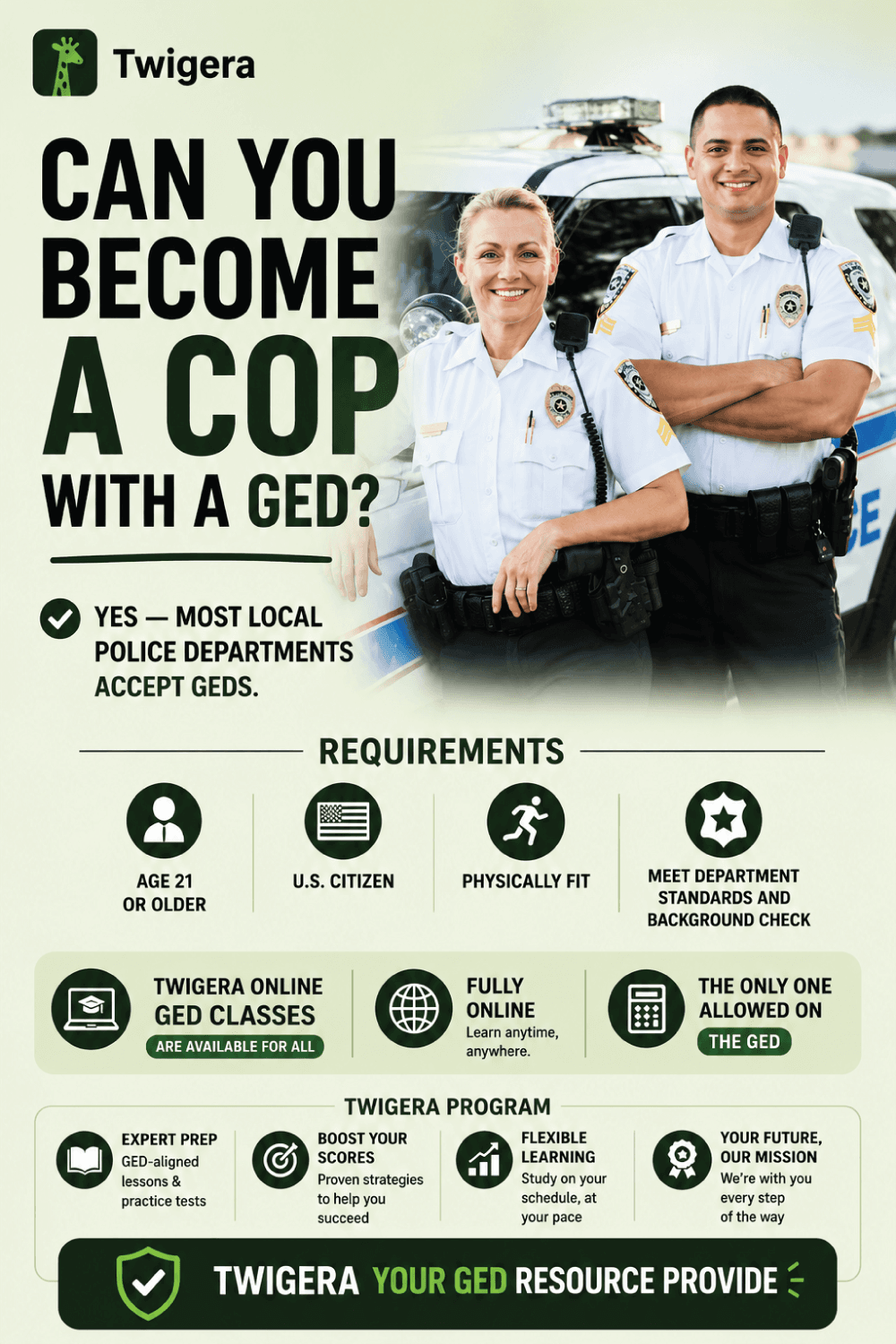
Are you asking yourself, can you become a cop with a GED? The short answer is yes — for most local and municipal police departments.
A GED equips you with the communication and logical reasoning skills police work demands. Having a GED does not disqualify you from a career in law enforcement, and combined with college credits, military experience, strong exam scores, and physical readiness, it can carry you a long way.
Where it gets harder is at the federal level. The FBI, DEA, and Secret Service almost always require a bachelor's degree, and state troopers often want 60 college credits on top of your GED.
In this guide, you'll see which departments accept GEDs, what requirements come after the education check, what police academy training looks like, and when extra college credits matter for state and federal roles.
Most local and municipal police departments accept GED holders. A GED fulfills the minimum educational requirement, allowing you to apply as long as you meet the other criteria — age, physical fitness, clean background, citizenship, and a valid driver's license.
For state police, a GED is often sufficient, but many departments prefer additional qualifications. Some states require up to 60 college credits or equivalent military experience alongside your GED to qualify.
Federal law enforcement is stricter. According to the FBI's official hiring guidelines, FBI special agents must hold a four-year degree and have at least two years of professional work experience. The DEA, Secret Service, and US Marshals follow similar rules — a GED alone is usually not enough.
A GED is the starting point, but police hiring goes well beyond your education credential. Departments care more about who you are after the GED — your record, your fitness, your judgment.
Here is what most departments require alongside the GED:
Requirement | What You Need to Know |
|---|
Age | Most departments require you to be at least 21 before becoming a sworn officer. Some cadet, reserve, or trainee programs accept applicants around 18. |
Citizenship | Many departments require US citizenship or meet state-approved citizenship rules. Always check the agency's current hiring page. |
Driver's license | You usually need a valid driver's license and a clean or acceptable driving record. Serious traffic issues can hurt your application. |
Clean criminal background | Felonies disqualify most candidates. Misdemeanors vary by department, charge type, timing, and evidence of changed behavior. |
Physical fitness test | Expect running, push-ups, sit-ups, obstacle courses, dummy drags, or other job-related tasks. The exact test depends on the agency. |
Written exam | Usually checks reading comprehension, reasoning, memory, grammar, and writing. Your GED helps, but exam prep still matters. |
Psychological evaluation | Departments use this to assess judgment, emotional control, stress response, and suitability for police work. |
Polygraph and drug screening | Some departments use a polygraph during hiring, and most run drug testing before hire. Prior drug-use rules differ by agency and state. |
Oral interview and background investigation | A panel may test your judgment, communication, ethics, and motivation. Investigators may review your employment, references, education, finances, driving history, and conduct. |
Academy length varies by state and agency. Police1 reports that basic academy training typically lasts 12 to 27 weeks, with an average of about 833 hours — roughly five months of training.
Earning your GED is step one. Keeping your record clean, training your body, preparing for the written exam, and treating every form, interview, and background question seriously — those are what get you across the finish line.
Police academy training usually lasts 16 to 28 weeks, depending on your state, department, and training-hour rules.
In many cases the academy is paid because you have already been hired as a recruit. Some candidates attend a self-sponsored academy first, so check your local process before applying.
Training covers criminal law, constitutional rights, report writing, defensive tactics, firearms, emergency driving, first aid, de-escalation, patrol procedures, and ethics. The physical side is demanding — expect running, strength training, obstacle courses, defensive tactics, long days, and strict discipline.
Some academies have a 10% to 20% washout rate, though this varies by program. Recruits may leave because of academics, fitness, conduct, injury, or failure to meet standards.
A GED does not place you in a separate track. Police academies treat GED holders the same as high school diploma holders once you meet entry requirements.
Federal law enforcement has stricter education rules than most local police jobs. For FBI special agents, applicants need a bachelor's degree plus full-time professional work experience.
Federal Agency | GED Enough? | Requirement |
|---|
FBI | No | Bachelor's degree plus 2 years of work experience |
DEA | No | Minimum education and/or qualifying job experience |
Secret Service | No | Bachelor's degree, graduate education, or specialized experience |
US Marshals | No | Bachelor's degree or specialized experience required |
ATF | No | Special-agent vacancies set education and experience standards |
CBP | Sometimes | A GED may work for some roles with qualifying experience |
USPS Inspection Service | Varies | Requirements depend on the open hiring announcement |
If you have a GED and want federal law enforcement, plan beyond the GED. Start with community college, move to a 4-year degree, then apply for federal roles. The path is longer, but it is open.
State police requirements vary by state, so do not assume one rule applies everywhere. Some agencies accept a GED, while others require a GED plus 60 college credits, military experience, or a combination of both.
If you want to become a state trooper, check your state police or highway patrol hiring page before applying. Pay attention to age, education, fitness, residency, background, and academy requirements.
Sheriff's departments are often more GED-friendly. Many county sheriff's offices follow requirements similar to municipal police, so a GED is often enough to meet the education minimum.
Sheriff's offices may hire for patrol deputy, jail deputy, court security, transport, or corrections roles. Each role can have different standards, even within the same county.
Some departments also offer cadet, explorer, reserve, or trainee programs for applicants around 18 to 20 years old. These can help you gain experience before applying for a sworn-officer role.
If you are asking can you become a cop with a GED, the answer starts with meeting the minimum requirement, then building a stronger application. Treat each step below as a milestone, not a checkbox:
Earn your GED. Aim for a College Ready score of 165+ if you plan to take college classes later.
Get physically fit. Start running, strength training, and practicing push-ups, sit-ups, and timed workouts well before you apply.
Keep your record clean. Avoid new arrests, drug issues, reckless driving, unpaid tickets, or any conduct that raises concerns during a background check.
Consider community college credits. An associate degree in criminal justice, psychology, or public safety can open more departments — especially state police and federal pathways.
Apply to multiple departments. Requirements vary by city, county, and state, so do not limit yourself to one agency. Cast a wide net while you train.
Prepare for the academy. Study civil service exam prep, follow how to get your GED in 6 steps if you have not finished yet, and train for academy-level fitness standards.
Law enforcement is one of several solid post-GED careers — nursing is another well-trodden path that accepts GEDs on equal footing with diplomas.
A GED is the starting point for most police jobs, especially with local police departments and sheriff's offices. For federal law enforcement roles, you'll often need a bachelor's degree, specialized experience, or both.
No matter where you apply, extra requirements still matter. You must meet standards for age, fitness, background checks, written exams, interviews, and police academy training.
Your GED is the credential that gets you in the door. What you build on top of it — your record, your fitness, your judgment — is what gets you sworn in.